Posts mit dem Label Diverses werden angezeigt. Alle Posts anzeigen

Donnerstag, 7. November 2019

An Experiment in Nettle Fibre Extraction

Recently the interest in nettle fibre production has grown a lot. Fashion designers tend to use more sustainable resources and nettle is on their agenda now for some time.
Extracting fibre from the Stinging Nettle, Urtica dioica, is nothing new throughout Europe.
Ötzi, the Tyrolean Iceman (dated between 3400 and 3100 BCE), used nettle fibres for the fletching of his arrows, he secured the feathers with fine nettle thread.
Then there is an interesting find from Denmark. In Voldtofte a shroud was found which consisted of fine woven nettle fabric. The fibres were analyzed and the results showed that the nettle fibre or the fabric itself was imported from the Styria region in Austria. This shows how important nettle production must have been during the Bronze Age, though flax already was cultivated and used for fibre purposes, too.
Later, in the 18th century, there have been endeavours to commercialize nettle cultivation on a big scale in Europe, but since nettle only has a fibre content of ca. 10%, other fibre plants were preferred.
During WWI there was no chance for Germany to geht hold of cotton, especially needed for durable uniforms. So people were asked to collect nettle stems and to bring them to collecting points. Farmers got money for cultivating nettle. Posters were found throughout Germany:


It was only after WWII, that nettle and other native fibre plants in most parts of Europe were replaced with cotton, since it was available again and the production costs got cheaper and cheaper.


Now, here is my own little experiment with nettle fibre.

It started with a bit of already processed fibre which I got from a friend at Lauresham. These fibres are carded and bleached. I spun this test batch on a drop spindle and I like the result. I plan to weave a little test patch from it soon, to see how it will behave when woven.


 So, the next step was to try to get fibre from fresh nettles. When Fimbulmyrk was here over the weekend, we took some tea with us and went into the forest. We gathered some nettle stalks and sat down on a big tree stump.

This is only one possibility to process nettles, there are many more and it seems that everyone doing this has their own tricks and preferences.

First of all we had to get rid of the leaves. But you can't strip them off like you wold do with peppermint, holding the tip and running your hand along the stem, as you would tear off some of the precious fibre, too. So you need to start at the bottom part. put on some gloves and pull the leaves and side stalks off very gently.

Now you should have some nice naked nettle stems. To get rid of the little hair which cause the stinging, run your hands along the stems a few times to brake off the hair.

In the next step you have to break the nodes. We took a random Stone from the ground and gently broke those thicker parts of the stem with it.


Now for the fun part: Scraping off the fibres with a knife while rotating the stem in your hand


Here is a little video showing the technique a bit closer:


What you end up with should look something like this:


With some of the fibres I then started a little experiment in itself. I made a simple cottage cheese by stirring some vinegar in warm milk. Then I took some of the fibres and put them in the remaining whey, weighted down with a saucer. I had initially planned to leave the fibre soaked only for some days, but life got in the way and I ended up with several weeks.


  But to my relief the fibres were still fine and the majority of wood particles had fermented away, as I had hoped for. The fibres are a bight brighter in colour now and much softer than the ones I only dried:

But I couldn't wait and since it was quite warm the fibres dried fast and I could do some test carding and spinning the same evening and I have to say, I was quite pleased.


Well, as I wrote, there were some weeks before I returned to my appartment. But that time wasn't nettleless, oh no! I camped at a medieval event and I had the opportunity to show people my endeavours in fibre extraction. They all were very interested, especially the children couldn't believe that this soft fibre once stung!
I told how to extract the fibres and showed how to card and spin them.


So, I guess, there is more to come soon! :D
And Fimbulmyrk seems to like working with nettles, too. When he arrived here for the weekend the last time, he showed me some lovely cord which he had made from nettle fibres and he brought me flowers! A whole bag full. Stripped ones. Well, nettle fibre, yes. And I like it a lot!


Oh, and the good thing about stinging nettle is, after stripping the leaves off and doing some hard work scraping, carding and spinning, you can reward yourself with some nettle tasties, like this pasta sauce frome nettle leaves, cream, salt, pepper and nutmeg.

 What a plant!


Dienstag, 5. November 2019

Birka Triangular Braid

During the last couple of weeks people in various viking age related groups on FB kept on searching for the technique to recreate a woollen braid from Birka. Several of these braids have been found, mostly to finish upper edges on apron dresses and most of these braids from Birka have a triangular cross section, as Geijer states in "Birka III. Die Textilfunde aus den Gräbern" (p. 128) You can download the Birka books here for free, directly from the Historiska Museet homepage!
Some people suggest finger loop braiding as the technique to achieve the right braiding pattern, but since I din't come across a pattern that would recreate a close enough resemblance to the original piece for my liking, I left it out.
Another possibility would be a different form of loop braiding, recently known as scoubidou braiding.
It is possible to get a triangular profile with this kind of braiding. If you use 3 strands of yarn, you will end up with a braid, that looks triangular from the top, but the problem is, it still turns into a spiral shaped braid, which is not the look of the original braid from Birka.


So, let's try another technique. 5 single strands of yarn, starting with a simple kot and securing it with a pin to a surface of your liking. I like to pin it to the knee and sit somewhere comfy.

I used different colours, so you can actually see what is happening while braiding.
First, put two strands on one side and the remaining three strands on the other side.


Then put thread 5 over 4, 3 and 2, placing it between 1 and 2.


Now, place thread 1 over 5 and 2, placing it between 2 and 3.


Take thread 2 and kind of twist it over 1, so it now is placed between 1 and 3.


 At this point I normally would tighten the whole thing, but I left this step out in this tutorial, as you wouldn't be able to see, what's happening next.
But please, if you try this, now is the perfect time to tighten your braid!


Basically, the braiding now starts from the beginning.
Put strand 4 over 3, 2 and 1, placing it between 5 and 1.


Put 1 over 4 and 1.


Twist 1 over 5, then tighten again.

If you follow these steps over and over again, you will end up with a braid like this:

Front

Back


To show you that this braid has a triangular cross section indeed, I put some pins on the sides of the braid:


Triangular indeed! :D


And how does it look in direct comparison the the original one from Birka?


Well, I guess we have some resemblance there, more than with any of the other techniques.
(Picture from "Birka III. Die Textilfunde aus den Gräbern", Tafel 33:7)


 A problem I came across while braidind was not loosing track of where I was, or rather where the threads should be when making a break. I solved this problem for me by using a scrap piece of cardboard and cutting some slots in it, so I could secure all the threads and the braid and start again after the break without any problem.


By using sock yarn weight wool I ended up with about the same size of the original piece.
I think I will use this as part of the new apron dress I'm planning with this lovely wool broken diamond twill soon! :)


Donnerstag, 9. April 2015

Sei Ein Echter Wahrer Held - Rette Mara!


Heute mal ein etwas anderer Post hier im Blog. Ich habe die Mara-Romane von Tommy Krappweis verschlungen. Jetzt hat der Autor sein Werk selbst verfilmt. Allerdings könnte der Zulauf weitaus größer sein, im Moment sieht es danach aus, dass der Film wegen fehlendem Publikum keinen zweiten oder gar dritten Teil bekommen wird, was er aber sowas von verdient hätte (und was ich persönlich auch sehr toll finden würde).
Die Meisten Leser hier haben die seltsame Zeit der Pubertät wohl hinter sich gelassen (oder sie kommt nur noch phasenweise durch ;)  ). Allerdings befindet man sich ja ständig auf einer Suche oder im Wandel, kennt also die Situation der 14-jährigen Mara Lorbeer durchaus. In der Schule gemobbt und als Tagträumerin abgestempelt, mit einer Eso-Tante als Mutter hat sie es nicht leicht, erst recht nicht, als ein Zweig anfängt, mit ihr zu sprechen. Als ob das nicht schon genug wäre, verkündet ihr die Botanik, dass sie eine Spákona, eine Seherin, sei und mal eben die Welt retten müsse, denn Ragnarök, das Endschicksal der Götter, sei nahe.
Das Mädchen, das sich bisher für allein auf weiter Flur hielt, bekommt Unterstützung. Auf wissenschaftlicher Ebene steht ihr Professor Weissinger zur Seite, der sich zu einem Freund entwickelt. Er ist Spezialist für germanische Mythologie, was ungemein hilfreich ist, denn Mara trifft in ihrer Âventiure
 auf einen Reigen mythologischer Wesenheiten, unter anderem den Lindwurmbezwinger Siegfried und den Halbgott Loki samt Frau Sigyn.
Auf ihrer Mission lernt sie viel über geschichtliche Hintergründe, sprachliche Feinheiten und dass sie kein perfekter, strahlender Held sein muss, um wirklich etwas zu bewegen, solange sie es nur versucht.

In diesem Film erschafft Tommy Krappweis einen ganz eigenen Mythos, vermittelt Wissen auf kurzweilige Art und Weise und rettet den Archetyp 'kleines Mädchen' aus der leider all zu oft verfilmten Rolle als wehrlose Nebenfigur, die auf ihren Helden wartet und gibt ihr ein Schwert in die Hand, um selbst ihren Weg zu gehen und daran zu wachsen.

Als wissenschaftlicher Berater stand dem Filmteam Prof. Dr. Rudolf Simek zur Seite. Daher sind die Verwendung von Sprachen wie Altnordisch und Mittelhochdeutsch genauso fundiert, wie die Ausstattung, von Waffen über Kleidung bis zum Hut des Professors ;)

Endlich ein Film, der mit Klischees aufräumt, die durch diverse TV-Produktionen in jüngerer Zeit leider immer weiter verbreitet wurden. Ein Film, der für alle Altersgruppen geeignet ist und der ganz einfach Spaß macht - und der es verdient hat, gesehen zu werden.

Daher meine Bitte: Geht mit allen, die ihr zu fassen bekommt in diesen Film! Lest die Bücher, tut etwas für eure grauen Zellen und habt auch noch Spaß dabei!


Montag, 1. April 2013

Vielseitigkeit

Um genau zu sein, 188 Seiten ;)

In der letzten Zeit habe ich viel Textilarbeit erledigt und brauchte mal etwas Abwechslung. Also warum nicht endlich mal etwas versuchen, was ich schon seit Ewigkeiten mal machen wollte. Mein Opa hat immer davon erzählt, dass mein Uropa Bücher gebunden hat. Und dann hat Joel mir mit seinem tollen Erstlingswerk noch den entscheidenden Schupser gegeben ;)

I've done a lot of textile work recently and needed something different. So why not try something new, which has always been on my mind since my grandpa told me about the bookbinding skills of my great-grandfather. And Joel inspired me to have a go eventually ;)

Die Werkzeuge waren vorhanden, Papier ist immer da, weil ja der Drucker gefüttert werden muss und eine gute Wikingerhausfrau hat immer ein paar Leinenreste da ;)
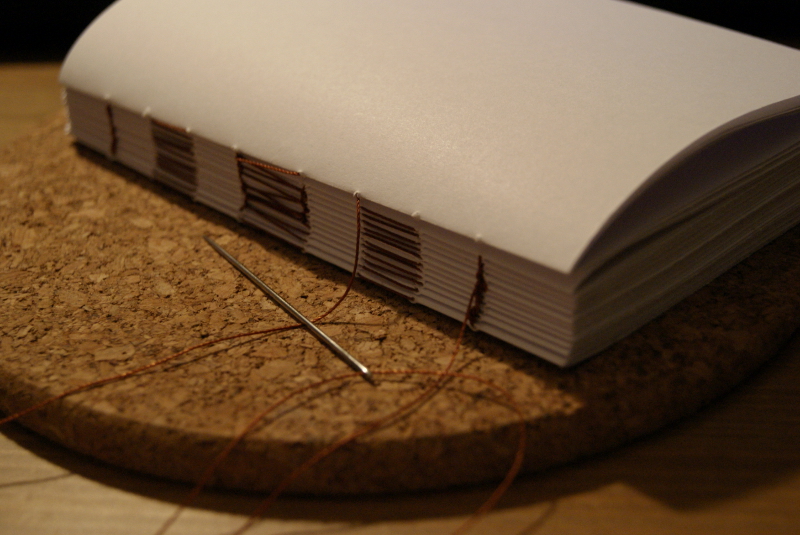
Also habe ich angefangen, Bögen zu falten und diese dann zusammenzunähen.

The required tools were already around, there's always paper in the house to feed the printer. And a good viking woman always keeps some linen scraps  ;)
So I folded some signatures from the paper and sewed them together.


Als alles an seinem Platz und schön festgezurrt war, habe ich an den Seiten des Blocks Kopfbänder genäht. Dazu habe ich Garn in zwei verschiedenen Farben verwendet, handgesponnen und pflanzengefärbt.

When everything was in place and tight, I sewed a headband on each end of the block.
I used threads of two different colours, handspun and plant dyed.


Dann habe ich einen Streifen Nesselstoff auf den Rücken geklebt und habe alles trocknen lassen.
Währenddessen habe ich mich an den Einband gemacht.
Dafür habe ich nur drei Stücke Pappe, etwas Leinen und Papier gebraucht. Das Papier habe ich vorher mit einem hübschen keltischen/Jugendstilmotiv bedruckt, da ja der schöne Papierladen in der Oberstadt mit den ganzen tollen Marmorpapieren (und der tollen kleinen Frau mit der riesigen Nestfrisur) am Feiertag zu hat.

Then I glued a strip of cloth to the spine and let it dry.
In the meantime I went to make the case.
I only used three pieces of cardboard, a bit linen cloth and paper. I printed a lovely celtic/art nouveau motif on the paper, as on a holiday the little paper shop with those beautiful marbled papers and the tiny lady with the BIG hair (formed to a nest *g*) was closed, of course.


Als dann alles getrocknet war, habe ich den Block in den Einband geklebt, habe die Innenseiten mit Papier verkleidet uuund:
Da isses, mein allererstes Buch :D

When all was dry I attached the block to the case, covered the inside with paper aaand:
Here it is. My first book :D

Das wird sicherlich nicht mein letztes sein. So ein Buch braucht ja Gesellschaft im Regal ;)

This will surely not be the last book. It needs company on the shelf ;)


Donnerstag, 14. Juni 2012

Auf zu neuen Abenteuern!

 Ich bin zwar selbst keine Larperin, aber der Großteil meines Freundeskreises questet am Wochenende gerne in fernen Landen herum und kloppt Orkse und anderes Geziefer. Oder ist selbst Ork.
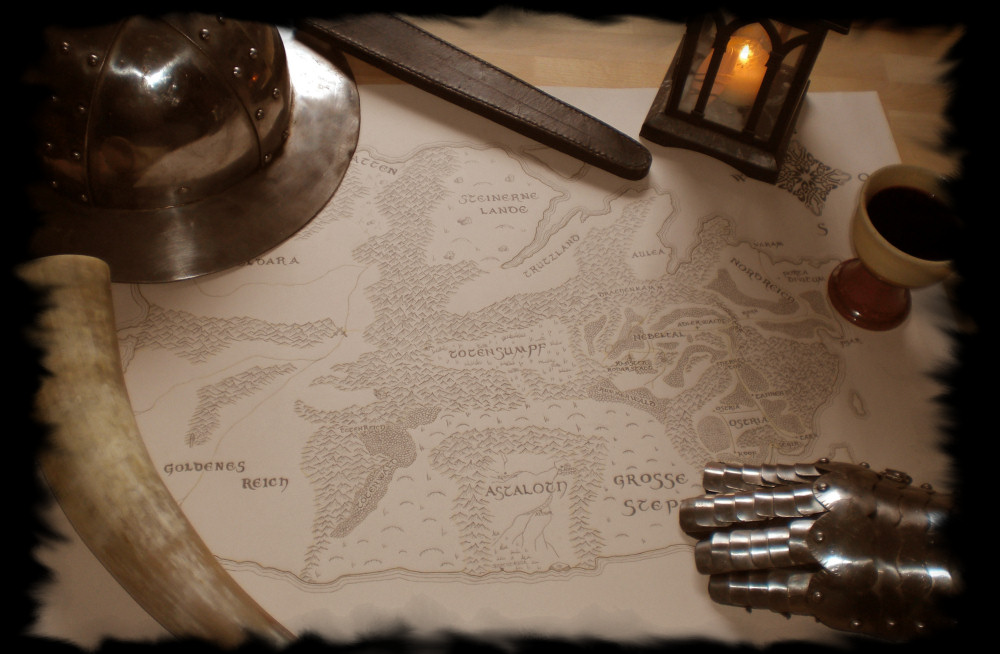
Im Oktober veranstalten einige Freunde eine Con auf der Tannenburg und ich wurde gefragt, ob ich ihre Welt in Kartenform bringen könnte. Da ich schon immer gerne fantastische Welten (zumindest in Teilen) gezeichnet habe, musste ich natürlich zustimmen ;)
Während ich also an der Handfasting-Klamotte für Herrn Fnu und Frau Mondjung gebastelt habe, ist auch noch eine 'kleine' Welt auf meinem Tisch entstanden. Meine Güte, gibt's da viele Berge *g*


Es sei noch angemerkt, dass sich scheinbar in ganz Marburg kein ordentliches ambientiges Papier in Din A1 auftreiben lässt. Also musste ich den Kontinent auf A2 quetschen. Ein hoch auf Druckbleistifte, auch wenn 0,5er Minen manchmal doch recht dick wirken können ;)

Die Seite der Veranstaltung ist heute online gegangen. Also, ihr lieben Larper, kommet herbei und meldet euch an! Noch sind nicht alle Infos auf der Seite fertig, aber behaltet sie schonmal im Auge!

Klickt hier, um auf die Seite zu gelangen!


Related Posts Plugin for WordPress, Blogger...